
Online, anonymous commentators have spilled a fair amount of ink in recent history trying to frame-up Nativism as a Communist conspiracy from the early 20th century. The problem in this theory is twofold. The commentary is devoid of a clear definition of “What Nativism is” and the commentary wrongly assumes concepts of Australian identity materialised after the second world war, or were exclusively held by Communists.
Nativism might mean something different to each player in a debate, and without clear terms of reference, any debate on the matter is futile as people argue past each other. We suggest that Nativism is quite simply the pre-ideological ideal of loyalty to one’s own native land and people; a loyalty that takes first priority amongst a circle of other potential loyalties, like that to our ancestral kindred in the British Isles or more broadly the European race. Nativism, of course, presumes a process of ethnogenesis; another word thrown around without much definition. We would suggest, ethnogenesis is the process of naturalisation and thus modification of a racial founding stock to a particular place over the course of time.
What is of great importance is that Nativism is pre-ideological; it does not necessarily import a particular ideology with it; although naturally, the Nativist will naturally be inclined to the ideology that best serves his paramount loyalty to his own people and home. Furthermore, he will incline towards that ideology which he sees as the traditional, organic expression of his people’s ideals.
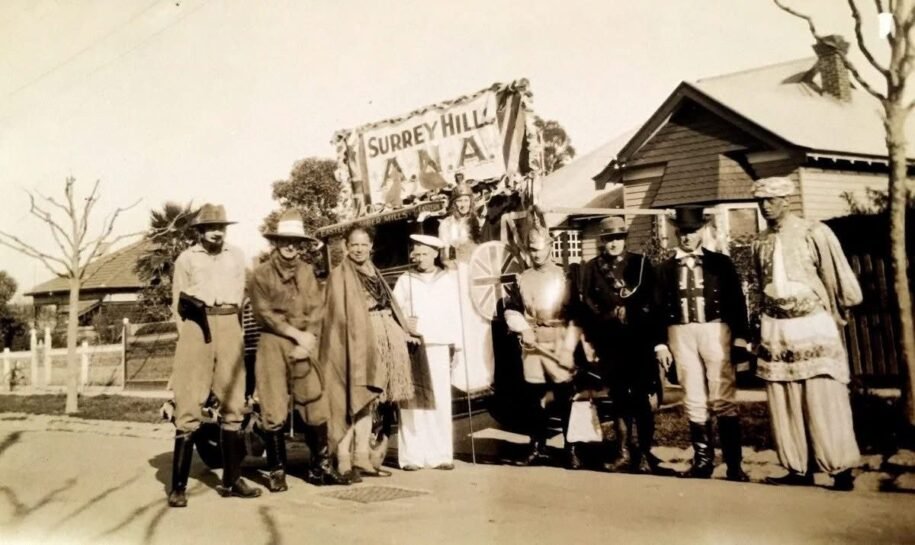
The Australian Natives’ Association, established in 1871, comfortably pre-dates the popularisation of Communist thinking in late 19th century Europe. And from the outset, the A.N.A. can be comfortably called a Nativist organisation as its membership was closed to foreigners, including those of British stock. This, however, does not mean the ANA was comprised of radical republicans. The Association at large ebbed and flowed in its characteristics in the late 19th century, sometimes with more republican sympathies, and at other times, more imperial sympathies. It was certainly never an existential issue, nor a contradiction for either side of the camp to acknowledge that (1) Yes, we are children descendant of the British Isles and (2) We have also become a unique nation, the Australian nation and should hold a principal loyalty to our own nation over all others. (3) Principal loyalty to Australia does not necessarily require complete separation from the imperial system, particularly where the imperial government is ready to “play ball” with legitimate Australian interests.
Henry Parkes, commonly known as the Father of Australian Federation, was not eligible to be a member of the ANA due to his English birth; but nonetheless, it must be acknowledged he articulated the consensus view of Australia about our identity and place in the world. Henry, speaking at a banquet in Sydney in 1891 proudly proclaimed:
“We contend that the time has come when the Australian people shall be one— when these Australian people shall be one—one now, henceforth, and for ever and ever. Hence, then, we say that this one people must make common cause and inherit one common destiny.
What does this imply? Any unintelligent and unnecessary attempt at setting up independent government? I contend that it means nothing of the sort— but that the great Australian people, increasing day by day, and year by year, not only in numbers, but in all the power which is conferred by bringing science into our service, and by bringing to bear upon our efforts all elements to advance civilisation—that this people, with all their advantages, desire to live as one people and to rival any other people in the constellation of States known as the British Empire.
We want to be Australian people, and as such a source of power and the brightest jewel in the crown of the Empire. To-night, surrounded by all the encouraging evidence that I see, I don’t disguise from myself the great obstacles that are before us, and the reasons that exist for possible partial failure. It may possibly be that the convention may not quite achieve all we desire; but it will do this, as sure as the sun will rise to-morrow: It will lay another stone in the foundation which all the force in the world cannot remove.
We embody in this toast that if we are one people we are supposed to share one destiny. (Loud cheers.) We seek to convey to the outside world that we have resources. We have material wealth; we have material strength; and we have the intellect and the enterprise that results from a well balanced intellect, to win our own destiny among the nations of the earth. We seek to win a place among the great free states that shall have no rival; that shall have equality with Great Britain itself; but we seek not separation.
We only seek to draw closer the bonds of empire and the bonds of true loyalty; but we contend that, whatever is the right and the privilege of the British subjects born within the shores of Great Britain, that right and that privilege must descend to us.
We seek a proud place undoubtedly; but it is the proud place of being the equals of the best of the British nation. At the same time we are preserving our Australian identity, and we seek that in the best way that is possible, that is, by federated power. We shall be masters of our own destiny and in entertaining this lofty ambition we are not prepared to take any second place amongst the civilised people of the world.
I claim that in taking our place side by side with the old country, with all her advantages, all her honor, and all her glories, we should be second to none of the older countries under the beneficent sway of the British crown, and we seek to give to our own existence in any scheme. We have Australian character and Australian coloring, so that the name Australian shall not be eclipsed by the name of Englishmen, Scotchmen, or Irishmen, in any part of the world.
The Australian soldier shall have no superior; the Australian workman shall have no superior. We seek then to build up here an Australia for ourselves; but, believing no other form of government would be better for us than that under which we now live, we seek to shatter no ties, only to create what we think is necessary for bringing about all the great faculties of our own individual existence.
I have often wondered why any person could quarrel with us in this cause. We are making war against no one. We seek to promote no principle to which just exception can be taken. Our cause is union, our cause is peace, our cause is the consolidation of Australian interests. The colony of New South Wales, for example, will be as free as she ever was. Victoria, in like manner, will be as free as ever she was, but Victoria and New South Wales and the other colonies united will have the power that they can only attain by federation, and that power alone will gain them their proper place in the family of nations. I ask you then, for I shall not further dwell upon the toast I am about to propose, I ask you with an unreserved feeling, with true hearts, earnestly engaged in this great work, to drink, “One people, one destiny.”
The above propositions shared by Parkes, are the comfortable middle-road that the ANA and the majority of Nativists have always walked. As is noted in Blackton’s Australian Nationality and Nativism: The Australian Natives’ Association, 1885-1901; leading figures in the ANA such as William Sowden took an Australia-first attitude whilst still being proud of the greatness of the wider British race. The ANA rejected the fringe radical-republicanism of the Bulletin whilst also rejecting the Anglophilia of the Argus which, among its contemporaries, was contemptuous of Colonial sensibilities and identity; Sowden confessed that the Association’s membership was “the happy medium between undesirable extremes” – This we submit would continue to be the case.
Nativism, as a pre-ideological ideal is by its nature a broad tent that incorporates both people of labourist, liberal, traditionalist and corporatist political traditions. It cuts across sectarian religious divides and has for many years proven a robust foundation for friendship, teamwork and mutual benefit for our unique people.
As noted in a prior essay, Ideology and Praxis – it is not necessary to develop a holistic, universal theory of everything in order to mobilise men for common objectives. Nativism is the broad ideal which alloves us to mobilise every man who loves and prioritises his people and his native land above all others.
More than a hundred years has passed since Mr Parkes made the above speech, and with that, there has been even more naturalisation of our people and further development in our uniquely Australian characteristics. Nonetheless, to this day, we still find his ambitions very agreeable. Of course the empire is long gone, though Australian Nationalists would be, as we previously expressed, keenly interested in International cooperation, trade and mutual defence with our racial kindred but, of course, not at the cost of our own self-determination or self-interest.
Was Henry Parkes a Communist by admitting the fact that we had in 1891 not only a unique Australian Identity, but also Australian character and Australian colouring? Was it necessary for him to hate the British race for him to assert this fact? Not at all. For in the Australian tradition, even some of the most flamboyant labourist voices, like Andrew Fisher, had significant loyalties to the broader interests of the British race (“to the last man and the last shilling”). Fisher, nonetheless argued against imperial interference in the debates on the Immigration Restriction Bill in 1901 stating:
“If there is to be an attempt to work up an agitation to show that Australians are an inferior class of people, who are to be governed and guided by Downing street, the sooner they are told that they are on the wrong track the better. Australians will then take a course which will not be at all palatable either to
Downing-street or to any other street.I would not tolerate for one moment the interference of British statesmen in a matter in regard to which we are sure of our facts. I would not for one moment remain in a Parliament which tolerated any such interference. I would rather be hounded out of Parliament twenty times over. I shall always resist any encroachment upon the right of Australia to govern itself in its own way.”
We hope the permanently online agitators would throw the weary pen aside and get involved in real life activities that are directed towards the welfare of the Australian people.
M. K. Grant
National Governor
October 2026