About Us
About Us
Nurturing Community, Fostering Solidarity, Building Tomorrow
'Our Own for Our Own'
Embracing tradition, fostering community, and upholding values. We support our members through camaraderie, character development, and mutual benefit. Join us in shaping Australia’s future together.
Who We Are
The Australian Natives’ Association is Australia’s leading nationalist fraternal organisation. Originally founded in 1871 and re-constituted in 2015, the Association is dedicated to advancing the legitimate ethnic interests of native-born descendants of the Australian founding stock and other loyal and naturalised European-descent settlers on our continent who call and treat Australia their native land.
Our nation’s founding stock who were European and principally Anglo-Celtic by descent desired and tirelessly fought for a Commonwealth that was substantially ethnically homogenous, provided high standards of living and good government. These ideals, having been abandoned by the political elite of this country, among other adverse conditions have made essential the reconstitution of what was once Australia’s leading bipartisan political nationalist force which served both political, cultural and community building purposes.
We advance our national interests through building and securing the foundational, institutional infrastructure needed to competently campaign for our interests in the public domain and which will also guarantee a future for our people regardless of whatever happens to the continent and its institutions at large.
Our branches stretch across the continent and are constituted by professional, sensible and competent Nationalists who are committed not merely to advancing our political interests in the long-term, but focusing on building immediate infrastructure to see to the immediate welfare and improvement of our members and securing a dignified future for our children and grandchildren.
Our Current Branches
The Australian Natives Association Canberra & Monaro branch has been active since 2015, following on from the original ANA Branch formed in 1927 which lived until the mid 20th century.
Based out of Brisbane, the branch currently encompasses the entire state of Queensland.
The Hobart branch, which admits members from all over Tasmania, was formally reincorporated in 2025, with an elected committee and members stretched over the apple isle with the view of securing a future for the Tasmanian folk regardless of the tides of politics across the country more broadly.
The Adelaide Branch was formally incorporated in 2026, with an elected committee, and is among the latest branches of the resurgent ANA.
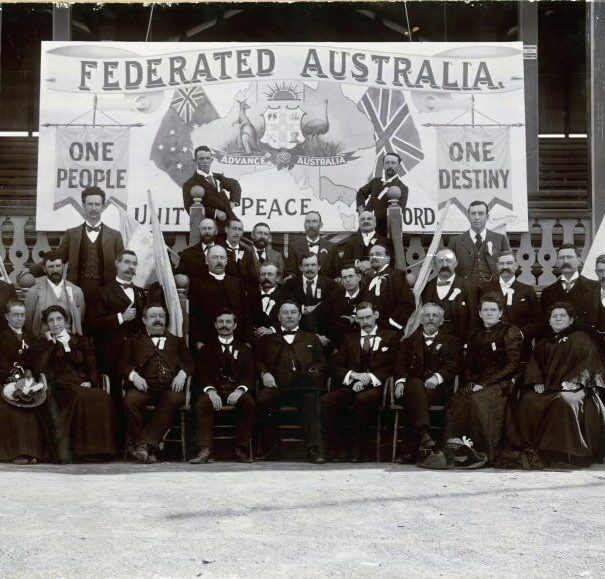
An honour roll for leadership
Our Association is an institution that encourages the improvement of its members with the view of aspiring them to grow in competency and leadership qualities. From the ranks of the old Association came many great patriotic leaders in Australia cutting across various ideological traditions but all sharing in an Australian-first vision for the future of the nation. Take a glance at some of our stories:
Alfred Deakin (1856–1919) was born in Collingwood, Melbourne, to British immigrant parents. He trained as a barrister and journalist before entering Victorian politics in the 1870s. As a life member of the Australian Natives’ Association (ANA), he used its platforms extensively, delivering key speeches that advanced Australian nationalism and Federation. The ANA regarded him as a leading orator and adopted him as a figurehead for the federal cause.
Deakin played a central role in the Federation movement. He represented Victoria at major conventions in 1890, 1891 and 1897–98, helping shape the draft Constitution. His famous 1898 speech to the ANA conference in Bendigo is widely credited with turning Victorian opinion decisively in favour of the Commonwealth Bill, contributing to the colony’s strong “Yes” vote. After Federation he served as Australia’s first Attorney-General and as Prime Minister in three non-consecutive terms (1903–04, 1905–08 and 1909–10).
In office Deakin advanced protectionist policies, social reforms and the foundations of Australian defence and industrial legislation. He remained closely associated with the ANA’s nationalist ideals throughout his career and is remembered as one of the principal architects of the Australian Commonwealth.
Edmund Barton (1849–1920) was born in Glebe, Sydney, and educated at Sydney Grammar School and the University of Sydney. He practised as a barrister and entered New South Wales politics in the late 1870s. As an Australian-born politician he became closely linked with the ANA, which strongly supported the Federation movement he led in New South Wales.
Barton emerged as the dominant federalist leader in his colony after Henry Parkes’s Tenterfield speech. He addressed hundreds of meetings, many organised or supported by ANA branches and Federation Leagues, and chaired the 1897–98 Federal Convention’s drafting committee. In 1901 the ANA held a banquet in his honour after he returned from London, where he had helped secure passage of the Commonwealth Constitution Act.
He became Australia’s first Prime Minister (1901–03), overseeing the establishment of the new Commonwealth institutions, before accepting appointment as one of the original justices of the High Court of Australia. Barton’s work, strongly backed by the ANA network, was instrumental in achieving national unity.
Sir Alexander James Peacock (1861–1933) was born in Creswick, Victoria, and worked as a legal manager for gold-mining companies. He joined the Creswick branch of the ANA in 1881, served as its secretary for two decades, and rose to become Chief President on three occasions (1885–87 and 1893–94). He remained on the ANA board of directors until 1904 and was a key figure during the organisation’s peak influence.
Through the ANA Peacock developed his “advanced Liberal” views, including support for democracy, women’s suffrage and state intervention for social welfare. The association provided a training ground and political network that helped launch his parliamentary career. He entered the Victorian Legislative Assembly in 1889 and held the seat of Clunes and Allandale (later Allandale) for a record 44 years. Peacock served in numerous ministries and was Premier of Victoria three times (1901–02, 1914–17 and 1924). He was known for factory legislation that improved working hours and conditions, and later as Speaker of the Legislative Assembly. His long involvement with the ANA linked him closely to the Federation cause and Australian nationalist politics.
Sir Isaac Alfred Isaacs (1855–1948) was born in Melbourne to Anglo-Jewish immigrant parents. A brilliant student, he worked as a pupil-teacher, studied law part-time, and built a successful barrister’s practice. He was an active member of the ANA in the 1880s and 1890s, speaking at its meetings on Federation, immigration restriction and democratic reform.
Isaacs entered the Victorian Parliament in 1892, serving as Solicitor-General and Attorney-General. Elected as a Victorian delegate to the 1897–98 Federal Convention, he initially urged caution on the draft Constitution at an ANA gathering but later campaigned vigorously for its adoption once the association endorsed it. After Federation he sat in the first Commonwealth Parliament before appointment to the High Court in 1906.He became Chief Justice in 1930 and, the following year, the first Australian-born Governor-General (1931–36). Isaacs’s judicial career emphasised national power under the Constitution, and his ANA involvement reflected the organisation’s role as a forum for ambitious Australian-born leaders.
James Henry Scullin (1876–1953) was born at Trawalla, Victoria, to Irish Catholic immigrant parents. After limited formal schooling he worked in various manual jobs and later managed a grocery store in Ballarat. He developed his public-speaking skills through the Catholic Young Men’s Society, local debating competitions and the Australian Natives’ Association.
Scullin joined the Labor movement around 1903 and entered federal Parliament in 1910. He lost his seat, edited a Labor newspaper, and returned to Parliament in 1922. As an Australian nationalist and strong supporter of the White Australia policy and protectionism, he rose to lead the federal Labor Party. In 1929 he became Australia’s first Australian-born Labor Prime Minister (and first of Irish Catholic background).His government faced the onset of the Great Depression and internal party divisions, ending in electoral defeat in 1931. Scullin remained a respected elder statesman in the Labor Party. His early participation in the ANA formed part of the network of self-improvement and nationalist societies that shaped many early Australian political leaders.
Francis Michael Forde (1890–1983) was born in Mitchell, Queensland, to Irish immigrant parents. Educated at Christian Brothers College, Toowoomba, he worked as a teacher, railway clerk and telegraphist. In Rockhampton he became active in the Australian Natives’ Association, serving as president of the local branch; this involvement marked the start of his public career.
Forde entered the Queensland Parliament in 1917 and won the federal seat of Capricornia in 1922. He served as a minister under James Scullin, then as deputy leader of the Opposition for many years. During the Second World War he was Deputy Prime Minister and Minister for the Army under John Curtin.Upon Curtin’s death in July 1945, Forde briefly served as Prime Minister (6–13 July) in a caretaker capacity before Ben Chifley was elected Labor leader. He later held the Defence portfolio, served as High Commissioner to Canada, and returned briefly to Queensland state politics. His early ANA membership connected him to the broader tradition of Australian-born political activism fostered by the association.
Sir John Quick (1852–1932) was born near St Ives, Cornwall, England, and migrated to the Bendigo goldfields as a child. After early work in the mines and as a reporter, he studied law at the University of Melbourne and practised as a barrister. Although not Australian-born, the Bendigo branch of the Australian Natives’ Association admitted him as an honorary member; he used the association’s networks to promote Federation and founded the Bendigo Federation League.
Quick’s most lasting contribution came at the 1893 Corowa Conference, where, as an ANA delegate, he proposed the practical plan that broke the Federation deadlock: popularly elected conventions to draft a constitution, followed by referendums in each colony. He drafted a model enabling bill, campaigned tirelessly for its adoption, and later served as a Victorian delegate to the 1897–98 Federal Convention. After Federation he entered the first Commonwealth Parliament as Member for Bendigo (1901–13) and co-authored the authoritative Annotated Constitution of the Australian Commonwealth with Robert Garran. Knighted in 1901 for his services to Federation, he later served as Deputy President of the Commonwealth Court of Conciliation and Arbitration.
Sir George Turner (1851–1916) was born in Melbourne and joined the Australian Natives’ Association in 1872, becoming treasurer of a city branch. Articled to Samuel Lyons (one of the ANA’s founders), he qualified as a solicitor and practised in Collins Street. He entered the Victorian Legislative Assembly in 1889 as one of a group of new members drawn from the ANA.
Turner rose rapidly in liberal politics, serving as Premier of Victoria from 1894 to 1899 and again from 1900 to 1901—the first Australian-born Premier of the colony. A moderate Protectionist, he initially hesitated over the Commonwealth Bill but was persuaded by Deakin and the ANA; he then gave it firm government support and chaired the 1899 premiers’ conference that secured final agreement. At Federation he became Australia’s first Commonwealth Treasurer under Edmund Barton and later Alfred Deakin, holding the portfolio until 1904 (and briefly again under George Reid). He retired from politics in 1906 and is remembered as a steady administrator who helped establish the financial foundations of the new nation.
James Hume Cook (1866–1942) was born in New Zealand and moved to Melbourne as a teenager. He worked in real estate, joined the Australian Natives’ Association in the late 1880s, and rose quickly: branch auditor, branch president within fifteen months, director by 1894, and Chief President in 1896. He later stated that he owed “almost everything” to the association.
Through the ANA he absorbed radical-liberal ideas—adult suffrage, the eight-hour day, land-value taxation and White Australia—and became an energetic advocate of Federation, helping persuade the association to support the 1897–98 Constitution Bill. He served as Mayor of Brunswick (1896) and sat in the Victorian Legislative Assembly (1894–1900). In the first Commonwealth Parliament he represented Bourke (1901–10) as a Protectionist, serving as Government Whip and a minister without portfolio under Deakin. After leaving Parliament he remained active in industrial and protectionist organisations and was appointed CMG in 1941.
William Alexander Watt (1871–1946) was born near Kyneton, Victoria, and educated largely through night classes and self-study. He joined the Australian Natives’ Association in the late 1880s, excelled in its debating competitions, became president of the North Melbourne branch, and served as a conference delegate. The ANA and the Australasian Federation League provided the platform on which he developed his oratory and nationalist outlook; he became a protégé of Alfred Deakin.
Watt entered the Victorian Legislative Assembly in 1897 and later served two short terms as Premier of Victoria (1912–13 and 1913–14). In 1914 he moved to federal politics. During the First World War he was Treasurer under Billy Hughes and acted as Prime Minister while Hughes was overseas. He concluded his parliamentary career as Speaker of the House of Representatives (1923–26). Known for his powerful speaking style and commitment to Australian national development, Watt’s early formation in the ANA linked him to the generation of liberal nationalists who shaped the early Commonwealth.