
National symbols are essential to strong national identity. They express the abstractions of nation in concrete terms, providing tangible entities around which the individuals who constitute the nation can unite and be subsumed into the whole. The pioneering men of Australia – including the men of the original Australian Natives’ Association – understood this. As part of their effort to forge a new nation from the discrete antipodean colonies of the British Empire, they actively sought and created such symbols. And in the wattle and the national flag of Australia, they found two of the most resonant and enduring.
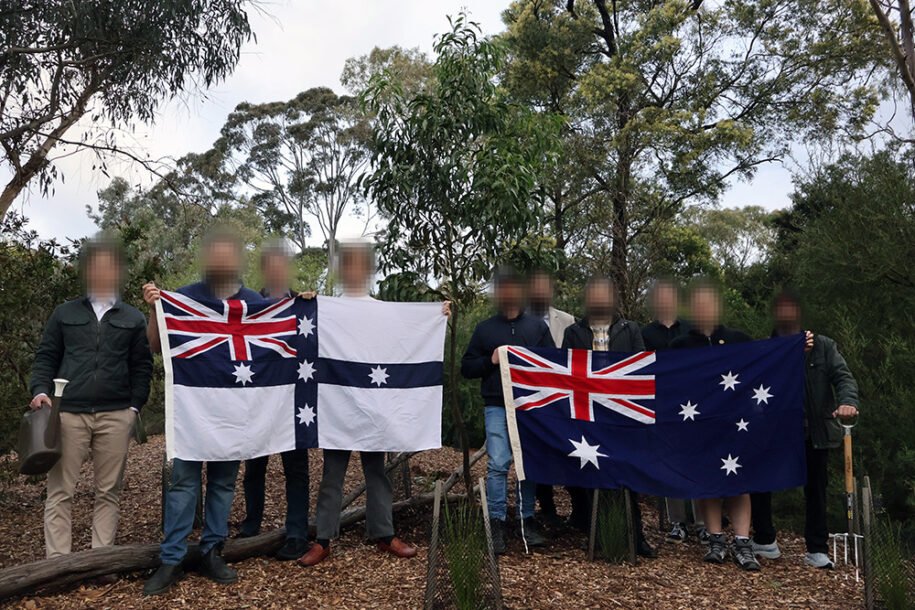
Like their forebears, the men of the Melbourne branch of the revived ANA recognise the power of these symbols. Earlier this month, for a fourth successive year, they visited the site of the ANA wattle tree in the hills northeast of Melbourne to commemorate Wattle Day. This year, however, marked the first time that this occasion doubled as an acknowledgement of Australian Flag Day.
Held each 1 September since 1912, and an officially gazetted Commonwealth observance since 1992, Wattle Day celebrates our national floral emblem – one chosen by our early symbolists for a ubiquity embodying the egalitarian nature of the new nation. Central to celebrations throughout that time has been the planting of wattles; but equally significant has been the attending to previously planted trees, an act laden with all the symbolism of the tree itself by representing the act of nurturing the young nation of Australia and watching it grow. Through the planting of the ANA wattle (specifically an Acacia pycnantha, or golden wattle) in 2023, the men of ANA Melbourne played their part in continuing the former tradition; and in the intervening years, they have continued the latter. This year, they were pleased to find their beloved plant, in full flower and substantially grown, needing little more than some light mulching and composting. And in the belief the wattle may possess further symbolic value still, they are confident the rude health of their specimen augurs well for the health and growth of their own branch in the years ahead.
The proximity of Wattle Day to Flag Day – observed each 3 September since 1996, and commemorating the date in 1901 on which the Australian flag was first flown – makes a compelling case for a joint acknowledgement of the two observances. For that reason, ANA Melbourne decided that, for the first time, its ceremonial plant care routine and traditional reading of W.H. Ogilvie’s “Sunny Country” (see text below) for Wattle Day would this year be supplemented with a brief flag unfurling ceremony and a short speech reflecting on the symbolic value of not one but three of Australia’s national flags: both the blue and red ensigns of the Australian national flag; and the “pre-national” national flag, the Federation flag. It was observed through this speech that, although the three flags have historically served different purposes (the blue ensign representative of the Australian government, the “red and Fed” combination representative of the Australian people), all have served as equally powerful symbols of nation through their common elements: the Union Jack, which represents the British origins of our founding stock; and the Southern Cross, which represents the new land through which we have been transformed into a new nation.
The ANA wishes all Australians a happy Wattle Day and a happy Flag Day, and we call on all patriots to take the time to stop and admire the wattle this spring and to fly our flag proudly wherever possible.
I dreamed of a sunny country last night, a golden dream
Of wattles down the gully, and of gum trees by the stream;
Of dancing haze and sides of blue, no other land can show
Save this, our sunny country, where the golden wattles grow.“Sunny Country” – W.H. Ogilvie