
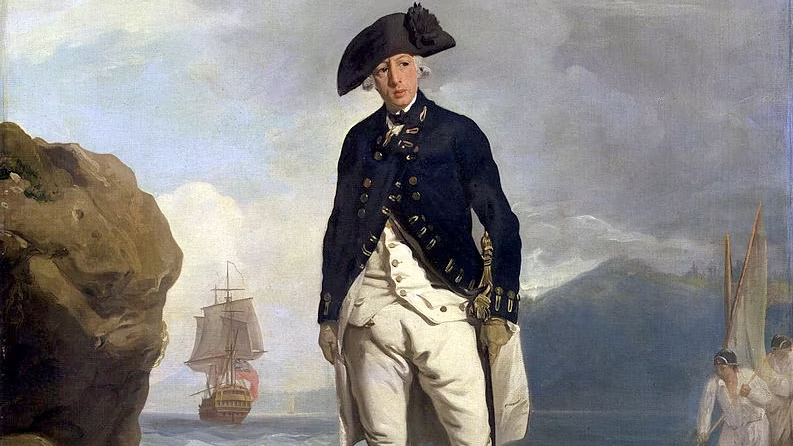
An address to the men of the Victorian branch of the Australian Natives’ Association
Strong nations rely on strong founding myths. By myth, I do not necessarily mean a story that is untrue; I mean a story elevated to the status of profound significance within a particular community. Myth is not so much about the truth of a story as about its treatment. The term founding myth, then, applies not merely to fictitious or legendary tales such as those of Aeneas, Romulus and Remus, Hengist and Horsa, and King Arthur; it applies equally to verifiable historical figures and events such as George Washington and the American Revolution. Founding myths provide nations with a unified sense of identity and instil pride, legitimacy, and confidence. And, as the examples just mentioned demonstrate, the strongest founding myths centre on heroic individuals, tangible figures whose deeds and traits serve as a model that the individual can aspire to emulate in the service of his nation.
It is my belief that the undermining of Australian identity through the relentless attacks on it in recent decades has been enabled by our lack of a clear founding myth. Our nearest equivalent is the ANZAC Legend, which our politicians repeatedly plunder through glib references to mateship, courage, and larrikinism as our defining traits. But important as the ANZAC Legend is, it is insufficient on its own, for it is a story of what we have become and where we have gone, and all such stories must be built on a foundation of who we are and where we have come from. And much as we admire the hero at the centre of this myth, the Digger, he is not quite real to us; for he is a composite, an ideal rather than the embodiment of one.
For true founding mythic potential, then, we must look back further. Specifically, we must look to the figures and events of our colonial past, through which the nation-building synthesis of race and place occurred. These, of course, once occupied a much more prominent and positive place in our national consciousness, before being swept aside through the critical re-evaluations of Marxist academics. But it would be inaccurate to suggest these figures and events ever held equivalent status here to what, for instance, Washington and the American Revolution do in the US. For while the latter represented a violent rupture from the parent nation through heroic struggle, the former were agents and actions of a British Empire serving British interests and were thus only gradually and retrospectively incorporated into the story of Australia.
Some of you would be aware that our committee has proposed our branch play an active role in addressing this issue; that we strive not merely to rehabilitate the image of these discarded colonials but also to elevate their place within the national consciousness above and beyond anything previous and so create a true founding myth. And, given his pre-eminence among these colonial names, Captain James Cook – the first European to set foot on the east coast of Australia, and the man who claimed this shoreline in the name of the British Crown – has featured prominently among these discussions as the most obvious mythic hero for such an undertaking. But given we are gathered here on the eve of Australia Day, I want to take this opportunity to advance the cause of the man whose feats lie at the heart of our commemoration; a man I believe at least equally worthy of the status of founding hero of Australia. I speak, of course, of Captain Arthur Phillip.
As the leader of the expedition that would become known as the First Fleet, Phillip oversaw the safe arrival of all 11 ships. These vessels, some of questionable seaworthiness, carried 1420 passengers some 24,000km in what historian David Hill has described as the biggest mass migration the world had ever seen. Throughout this journey, just 48 passengers were lost. Most of these were in poor health and unfit to sail before departure, and the vast majority of the remainder were reported to be in remarkable condition on arrival. Within five years, a stable food supply had been established in the farming district of Rose Hill, and the fledgling colony that was to become the great nation of Australia was well on its way.
These things did not simply happen through good fortune; they were the result of Phillip’s decisive leadership, lateral thinking, and calm under pressure. It was Phillip who ensured an additional ship be added to the Fleet to prevent overcrowding. It was Phillip who ordered the ships awaiting departure be cleared and fumigated to arrest the spread of a potentially disastrous outbreak of disease. It was Phillip who broke the strike that eventually allowed the fleet to set sail. It was Phillip who defied convention by allowing convicts above deck both day and night to promote good health. It was Phillip who took the unusual course of avoiding stopping at the Cape Verde Islands and instead sailing across the Atlantic for Rio de Janeiro, allowing the Fleet to both avoid treacherous conditions and take advantage of favourable winds. It was Phillip who, on the advice of surgeon John White, again curtailed the outbreak of disease by ordering relentless pumping of the bilges to cleanse them of foul water. It was Phillip who earnestly entreated the governor of the Dutch Cape Colony to furnish his ships with vital supplies for the final leg of the journey after initially meeting resistance from local officials. It was Phillip who throughout all of this prevented two mutinies. It was Phillip who made the momentous decision to abandon Cook’s proposed settlement site of Botany Bay in favour of the far superior Port Jackson. Perhaps most importantly, it was Phillip as first Governor of New South Wales who led the fledgling colony through and ultimately out of the food shortage crisis of its first five years, a product of the unimaginably hostile terrain encountered by the settlers. And it was Phillip who throughout this great struggle remained steadfast in his effort to develop and maintain friendly relations with the local Aboriginal people, refusing to retaliate even after suffering a near-fatal spearing.
For all of this, Arthur Phillip is a hero. And for his heroism, his reward has been to fade from our collective memory, his name and achievements either forgotten entirely or, perhaps more frequently, conflated with those of Cook. In 2018, not one but two federal politicians publicly referred to Australia Day as the anniversary of the day on which Cook first set foot on Australian soil. If their gaffes were embarrassing, they were at least in good company; a 2020 poll commission by the Federal Government had 47 per cent of respondents say the same thing.
This is, in a way, understandable. Cook, after all, almost perfectly fits the Jungian archetype of the explorer, and thus the bare outline of his exploits resonates in a way that of Phillip’s does not. But an Australian founding myth needs the First Fleet and thus needs Phillip; for our synthesis of race and place depend upon an act of settlement. Yet in weighing the merits of these two men, we need not be forced into an either/or situation; we can, perhaps, have our lamington and eat it too. Founding myths involving voyage, discovery, and settlement often condense these acts into a single, continuous event by a single heroic figure or group, but not exclusively so. Perhaps the most notable exception is the story of Ith and the Milesians from the 11th century mythical Irish history the Lebor Gabála Érenn. According to this legend, Ith, the brother of the leader of a group of exiled Scythians named Mil, spies the distant shore of Ireland from a tower in Hispania. He sets sail and, on arrival, is welcomed by three kings before being killed by unnamed attackers. As an act of retribution, Mil’s eight sons lead an invading force and conquer Ireland, becoming the progenitors of the present-day Gaelic people.
The parallels between this story and the combined exploits of Cook and Phillip are striking. Both involve an initial act of discovery and a later act of settlement that combine to form a coherent and unified origin story grounded in the heroism of its key characters. Only one, however, has attained the status of founding myth. The other is, for now, simply a true story; but it is within our power to change that.
So to the aspiring storytellers, poets, bush minstrels, and artists and content creators of various other persuasions here present, I implore you: take the raw material of our origins and fashion it into something that transcends its substance and captures the Australian imagination. Give us our founding myth. But give us one with sufficient breadth. Give us Cook, yes, but not just Cook; in the spirit of Ith and the Milesians, given us Cook and the Phillipians. Do so to make them, both these men, the heroes we need and the heroes they deserve to be. And to all of you: as you celebrate on Australia Day and reflect on the events it commemorates and what they spawned, take a moment to pay your respects to the man who made it all possible.
M.J.Brown
24 January 2026