
An address to the men of the Victorian branch of the Australian Natives’ Association
2026 is upon us, and with it the rituals that accompany the arrival of each new year. Across Australia, revellers are nursing sore heads received courtesy of last night’s excesses. Those feeling a little less out or sorts and a little more inspired are busily writing their lists of resolutions – many overly ambitious, most soon to be discarded. In many cases, the two will intersect in the form of pledges to not get quite so carried away this time next year. But few, I suspect, are doing as we are now: gathering to honour, or even privately acknowledging, the 125th anniversary – the quasquicentennial, if you will – of the federation of our fair nation.
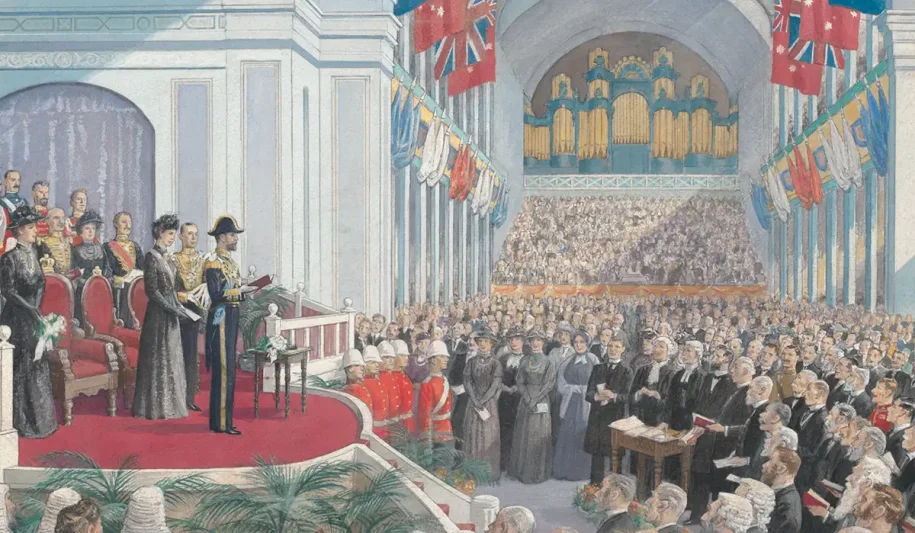
It has always been thus. In deciding upon a date for the historic union of the colonies, a majority of the six premiers were drawn to the idea of the new nation coming into being on the first day of a new century. Sadly, few others were. After the pomp and circumstance of 1901 – a procession through the streets of Sydney and an inauguration ceremony in Centennial Park – 1 January reverted to simply being New Year’s Day, and Federation Day was all but forgotten. It is perhaps worth noting that our forebears in the original ANA campaigned for Federation to take place on Australia Day – Foundation Day as it was then – and so bring our national story full circle with a neat bit of symmetry. With the benefit of hindsight, we may easily see the wisdom of this proposal.
And so, while the anniversary of the arrival of the First Fleet is now afforded national day status, drawing controversy yet remaining ever popular among ordinary Australians, the anniversary of Federation passes by each year largely unnoticed. But it is an occasion that warrants the attention of all nativists. There is, of course, the fact that Federation allowed passage of, and was to a certain extent driven by the desire for, the Immigration Restriction Act of 1901, a policy that helped drive Australia’s high standard of living and served as the cornerstone of its cultural identity for almost 70 years. Yet only, as a I say, to a certain extent; for the popular view of Federation as an act of political expediency is a limited one. A federal government certainly made the process of immigration restriction simpler, but it was not essential, as evidenced by the major threat of Chinese immigration having already been addressed by the collective policies of the former colonies. In fact, as the late John Hirst notes in his landmark work The Sentimental Nation, the six colonial governments had already been operating at a national scale prior to Federation. They had managed to coordinate intercolonial train, telegraph, and mail networks and provided for the defence of the continent, and they were hardly likely to surrender their autonomy simply to streamline such processes going forward.
How, then, to explain Federation? Hirst’s title is instructive, for it points to a simple yet powerful thesis: Australia became a Federation not out of necessity but desire. She became a nation because her people recognised her as such and wished it made official. In doing so, they advanced the central idea of Australian nativism: that the Australian people, although of British and assimilated European stock, have over time been transformed by this unique landscape to themselves become something unique. We rightly celebrate 26 January as the beginning of our connection with this land. It is a fitting national day. But Federation Day deserves to rank alongside it. For if Australia Day marks the first step on the road to nationhood, Federation Day marks the end of that journey.
I urge all of you, then, to use this milestone anniversary as the impetus to forge, renew, or strengthen your connection with Federation Day. Our branch will continue to formally honour it, and we hope you will continue to join us in this. But whether in the form of an official commemoration or otherwise, take the time each New Year to reflect on the significance of 1 January to our national story, and encourage other patriotic Australians to do the same. Federation was the moment that the Australian people, recognising who they were, took their destiny into their own hands. By remembering this, we may just come to remember ourselves and to once again forge our own path forward.
M.J. Brown
1 January 2026