
The will to endure in the often-serious business of nativism depends upon embracing and creating opportunities for levity. These do not merely provide welcome relief to rejuvenate us for the long fight ahead; they also sharpen our focus by reminding us of the kind of Australia for which we fight: one where the dry, irreverent, and laconic bushman’s wit remains at the core of our identity.
It was with this firmly in mind that the men of the ANA Victorian branch gathered recently for a particularly light-hearted edition of Banjo Paterson Night. The event, held on or around each 17 February (i.e. the anniversary of Paterson’s birth in 1864), celebrates the life and works of our iconic bush bard as well as the broader Australian school of poetry he helped define; and, although it draws obvious inspiration from Burns Night, held each 25 January in honour of Scottish national poet Robert Burns, it has in its mere three years of existence evolved to take on a life and character all of its own. Besides adopting, in typical Australian fashion, a more informal, relaxed structure, Banjo Night has also developed to centre on a different theme each year, allowing each edition to focus on a different aspect of Paterson’s massive corpus of work and so ensure sufficient variety from year to year. And, following a gruelling start to 2026 for many of our members in their organisation-building efforts, comic verse was dubbed an appropriate theme on this occasion as a means of securing those aforementioned vital moments of mirth.
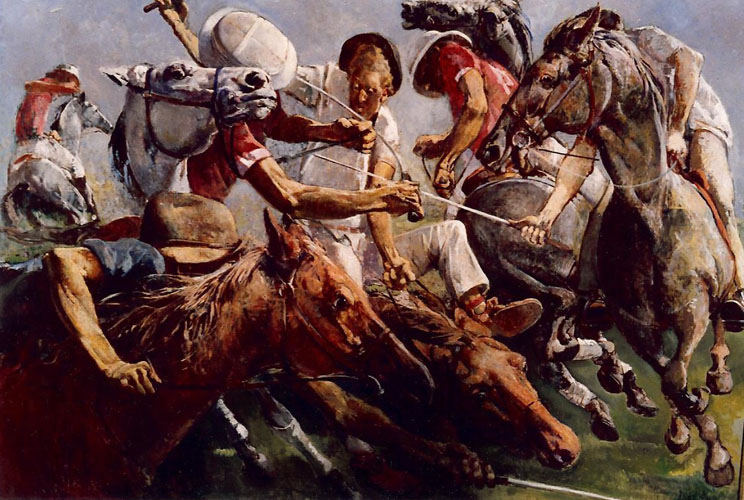
Naturally, poetry readings dominated the evening’s proceedings; and, naturally, it was Paterson himself who provided the bulk of the material. Alongside readings of two of his most famous works in “The Geebung Polo Club” and “The Man from Ironbark” were those of “Frying Pan’s Theology” and “Johnson’s Antidote”, both of which seem to anticipate and brilliantly skewer present-day assumptions of Aboriginal sapience; and “Come-by-Chance”, a finely crafted parody of Edgar Allan Poe’s “The Raven” – complete with matching trochaic octameter – that testifies to the breadth of Paterson’s literary knowledge and skill. However, the evening also afforded opportunity to acknowledge those poets who followed in Paterson’s comic footsteps. A reading of C.J. Dennis’ “The Stoush O’ Day” reminded all present of his undisputed claim to the title of “laureate of the larrikin”; and John O’Grady’s “The Integrated Adjective” served as a celebration of that very Australian fondness for tmesis.
Planning is already underway for the 2027 edition of Banjo Paterson Night, and the ANA encourages all patriotic Australians to join its members on or around each 17 February in celebrating our national poet and the richness of the wider Australian literary tradition to which he belongs.